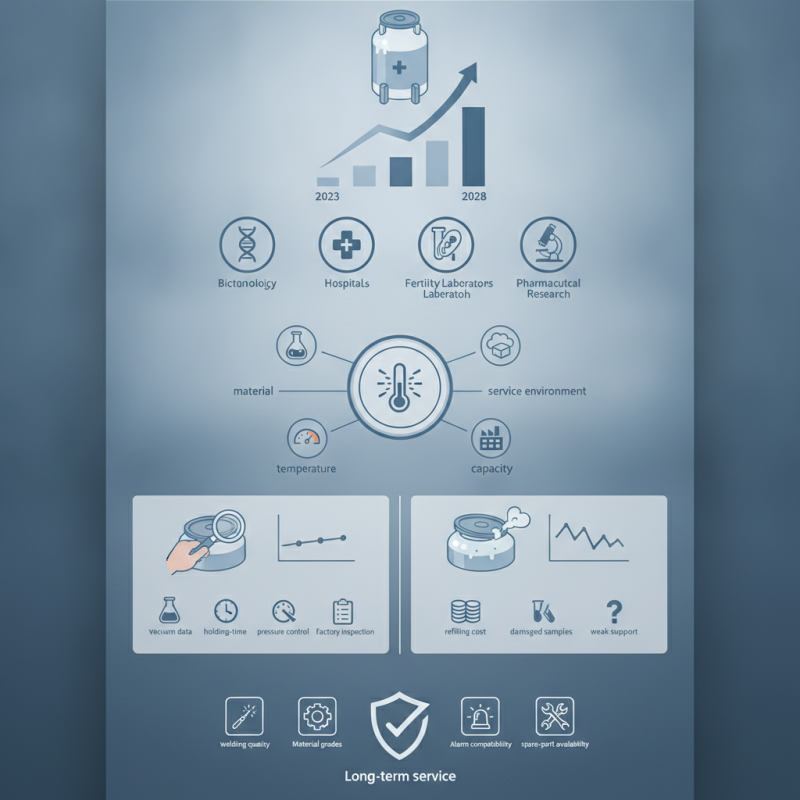
Choosing the best China cryostorage tank manufacturer requires more than comparing prices. It requires evidence, testing, and practical judgment. MarketsandMarkets reports that the global cryogenic equipment market may grow from approximately USD 24.9 billion in 2023 to USD 30.4 billion by 2028. This growth reflects expanding demand from biotechnology, hospitals, fertility laboratories, and pharmaceutical research. However, market growth does not guarantee reliable equipment.
A suitable cryostorage tank should match the stored material, working temperature, vapor-loss target, capacity, and service environment. Dr. Peter Mazur, a leading cryobiologist, stated, “The key to successful cryopreservation is the control of ice formation.” His principle also applies to tank selection. Stable temperature performance matters. So does lid design. A poorly sealed lid can increase nitrogen loss, frost formation, and handling risk. Ask manufacturers for vacuum-insulation data, holding-time tests, pressure-control details, and documented factory inspections. Request evidence, not promises.
Reports from Grand View Research also identify biotechnology and healthcare as important drivers of cryogenic equipment demand. That trend is useful, but it can encourage rushed purchasing. A cheaper cryostorage tank may create higher costs through frequent refilling, damaged samples, or weak after-sales support. Some specifications look impressive on paper. They may perform differently in a busy laboratory with repeated access. This is where careful evaluation becomes essential. Check welding quality, material grades, alarm compatibility, spare-part availability, and technician response times. China offers many capable manufacturers, yet not every supplier provides the same engineering depth. The strongest choice combines verified performance, transparent communication, and long-term service. Small details often decide whether a tank protects samples quietly for years.
Cryostorage tanks are insulated vessels designed to preserve biological materials at ultra-low temperatures. Most use liquid nitrogen, maintaining approximately -196°C in the liquid phase. Some systems use nitrogen vapor, usually between -150°C and -190°C. The design controls temperature stability, evaporation, access, and sample traceability. A tank is not simply a large thermos.
Their main applications include biobanks, fertility laboratories, cell therapy research, vaccine development, and long-term specimen storage. In reproductive medicine, tanks may hold embryos, oocytes, sperm, and reproductive tissue. Biobanks store blood, DNA, tissues, and research samples in labeled racks. Cell and gene therapy laboratories require stricter monitoring because small temperature changes can damage valuable materials. The ISBER Best Practices document emphasizes validated storage, alarm systems, inventory control, and documented emergency procedures.
Market data shows the scale of this demand. Grand View Research estimated the global cryogenic equipment market at approximately USD 21.96 billion in 2023. Its forecast indicates continued growth through 2030, supported by healthcare and biotechnology applications. The International Society for Cell and Gene Therapy also reports expanding clinical activity, increasing pressure for reliable cold-chain infrastructure. Data can vary between reports.
When choosing a tank manufacturer, users should compare working volume, vapor loss, temperature uniformity, alarm response, and service capability. A larger tank is not always better. Poor access can slow retrieval and increase handling errors. That detail is often underestimated. Select the tank around real samples, staff routines, monitoring rules, and future capacity, not only advertised specifications.
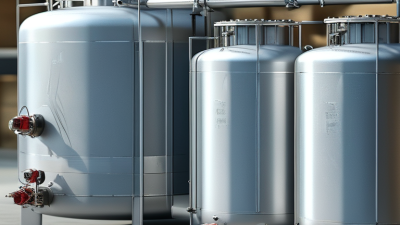
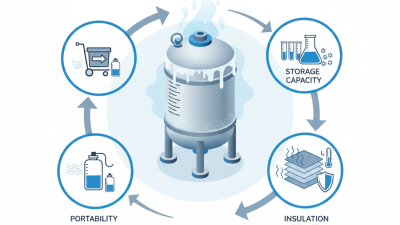
Cryostorage tanks are highly insulated vessels designed to preserve biological materials at cryogenic temperatures. Liquid nitrogen systems are widely used for cells, tissues, embryos, sperm, oocytes, vaccines, and other temperature-sensitive biological samples.
The chart compares representative operating temperatures. Liquid-phase nitrogen storage is approximately −196°C, while vapor-phase and dry-shipper systems are commonly designed to maintain sample environments at or below approximately −150°C. Actual performance depends on tank design, liquid level, loading pattern, monitoring, and operating procedures.
Choosing a cryostorage tank starts with the specimen, not the catalogue. Define sample type, vial format, daily retrievals, and required holding time. NIST lists nitrogen’s normal boiling point as 77.36 K, or −195.79°C. That temperature is not enough. Decide whether samples require liquid-phase storage or vapor-phase protection. Vaccine materials, reproductive specimens, and research cells may have different thermal limits.
Capacity calculations should include current inventory, five-year growth, and usable rack space. A 600-liter tank may not provide 600 liters of practical storage. Rack geometry, neck diameter, and retrieval frequency can reduce efficiency. Ask for static evaporation data, holdover time, oxygen-deficiency alarms, and level-monitoring accuracy.
ISO 21009-1:2022 addresses cryogenic vessel design and fabrication, while ISO 21009-2:2023 covers operational requirements. These references help separate engineering evidence from sales language.
ISBER Best Practices, 5th edition, emphasizes documented temperature mapping, alarm verification, access control, and emergency planning. Require factory test records, calibration certificates, and a clear maintenance schedule. Confirm whether the facility has suitable ventilation and backup transfer procedures.
Small details matter, such as gloves fitting under the access lid. A perfect specification is unlikely. I would still challenge any supplier that cannot explain its assumptions, measurement methods, and failure response in writing.
Choosing the best cryostorage tank manufacturer in China requires more than comparing prices. Start with materials. Stainless steel offers strong corrosion resistance and long service life. Aluminum tanks are lighter, but they may need more careful handling. Ask for material certificates, weld inspection records, and pressure-test results. A polished interior also helps reduce contamination risks during repeated filling.
Capacity should match your real workload, not an optimistic estimate. A tank with excessive space can increase nitrogen loss and maintenance costs. A small tank may require frequent refilling. Check usable capacity, storage position, neck size, and expected holding time. Safety features matter equally. Look for vacuum insulation, pressure relief devices, level indicators, temperature alarms, and secure lids. These details protect samples when staff are busy or power fails.
Tips: Request a factory acceptance test and review sensor calibration records. Confirm whether temperature monitoring is continuous or manual. Ask how alarms behave during low levels or pressure changes. Do not rely only on catalog data. A larger tank is not automatically safer. In practice, poor access can cause handling mistakes. I would also test the alarm system under realistic conditions, because an impressive specification can still perform poorly in daily use. Temperature control deserves careful attention. Passive cryogenic tanks maintain cold conditions through evaporation management, not active cooling, so refill planning remains essential.
Choosing a Chinese cryostorage tank manufacturer requires more than comparing prices or polished factory photos. Evaluate the production system behind each vessel. Ask for material certificates, weld maps, inspection records, and serial-number traceability. Stainless steel surfaces should show consistent finishing, with no sharp seams or visible contamination. A factory visit can reveal practical details, including clean assembly areas, calibrated instruments, and protected vacuum lines. Details matter. Request evidence from recent, comparable tanks, not generic samples.
Quality documents should connect directly to performance. Review vacuum retention data, evaporation-rate testing, pressure protection, temperature monitoring, and alarm verification. Confirm how technicians inspect insulation, valves, lids, and transfer accessories before shipment. Independent testing can strengthen confidence, especially for larger systems. Check whether the manufacturer follows a documented quality system, such as ISO 9001. Verify whether its pressure-related design meets the rules applying in your destination market. Certificates alone are not enough. Their scope, issuer, date, and product relevance need checking.
Compliance also includes installation guidance, user training, maintenance schedules, and incident-response procedures. Ask for English manuals, spare-parts policies, calibration support, and clear warranty terms. A reliable supplier should explain design limits without making unrealistic promises. Be careful with claims such as “zero maintenance” or “permanent vacuum.” Do not guess. No audit is perfect. In practical evaluations, after-sales response deserves the same attention as welding quality, because a small valve problem can interrupt years of stored samples. Keep written answers, compare evidence, and revisit weak points before signing.
When choosing China’s best cryostorage tank manufacturer, service should be tested before price is discussed. Ask for drawings, material certificates, pressure-test records, and a clear maintenance schedule. A technically capable supplier can explain evaporation rates, vacuum performance, temperature monitoring, and safe filling procedures in plain English. Request a named engineer, response times, remote troubleshooting, and on-site commissioning. Small details matter: training should include alarm checks, lid inspection, and recovery after a power interruption. Do not accept vague promises. Get them written.
Compare total ownership cost, not only the quoted tank price. Include freight, customs handling, installation, calibration, spare parts, and future vacuum maintenance. A tank with slightly higher purchase cost may reduce nitrogen loss through better insulation and stable vacuum design. Ask for measured evaporation data, test conditions, and expected service intervals. Figures can be polished. Verify them. An honest supplier should explain assumptions and admit where performance may vary. That admission often builds more trust than perfect marketing language.
Warranty terms deserve line-by-line review. Check coverage for the vessel, valves, sensors, vacuum layer, and workmanship. Confirm exclusions, claim documents, labor costs, and repair or replacement timelines. Delivery terms should state production lead time, inspection rights, packaging, insurance, and responsibility for delays. A pre-shipment video inspection can reveal damaged fittings or missing accessories before dispatch. Request references from laboratories using similar capacities. Local technical support may matter more than a small discount when stored samples need stable conditions.
Use the following practical benchmark table to compare cryogenic storage tank suppliers by service, cost, warranty, and delivery terms. Actual specifications, prices, and lead times should be confirmed in the supplier’s written quotation.
| Evaluation Dimension | Key Item to Check | Recommended Benchmark | Documents or Evidence to Request | Suggested Weight | Rating |
|---|---|---|---|---|---|
| Product Safety | Tank design and pressure classification | Confirm the working pressure, design pressure, vacuum insulation design, relief-device settings, and applicable local regulations before ordering. | Technical datasheet, approved drawings, pressure-vessel certificate, material certificates, and safety-device specifications. | 20% | 1–5 |
| Capacity Selection | Nominal and usable capacity | Compare both nominal capacity and usable working capacity. A practical selection should include additional volume for operating flexibility and transfer losses. | Capacity curve, dimensional drawing, usable-volume definition, and recommended filling limit. | 8% | 1–5 |
| Thermal Performance | Static evaporation rate | Request a tested static evaporation rate under clearly stated conditions. Lower evaporation generally reduces cryogen consumption, but the test method and ambient conditions must be comparable. | Test report stating cryogen type, ambient temperature, measurement period, tank condition, and calculation method. | 12% | 1–5 |
| Material Quality | Inner vessel, outer shell, and insulation | Verify material grades, weld quality, vacuum insulation, surface treatment, and compatibility with the intended cryogenic medium. | Material certificates, welding procedure records, non-destructive testing records, and insulation specifications. | 8% | 1–5 |
| Service Capability | Technical consultation before purchase | The supplier should help select capacity, pressure, outlet configuration, monitoring devices, transport method, and installation requirements. | Completed technical questionnaire, application review, configuration drawing, and named technical contact. | 10% | 1–5 |
| Service Capability | Installation and commissioning support | Prefer suppliers offering installation guidance, operating procedures, safety training, and remote or on-site commissioning support when required. | Installation manual, commissioning checklist, training plan, and service response procedure. | 8% | 1–5 |
| After-Sales Support | Spare parts and maintenance | Confirm availability of valves, gauges, sensors, vacuum components, seals, and other service parts. Replacement procedures should be documented. | Spare-parts list, recommended maintenance schedule, service manuals, and parts lead-time statement. | 7% | 1–5 |
| Total Cost | Purchase price and included scope | Compare the complete delivered cost rather than the tank price alone. Include accessories, testing, packaging, documentation, inland transport, insurance, duties, and installation. | Itemized quotation, commercial invoice template, packing list, accessory list, and clearly stated exclusions. | 10% | 1–5 |
| Operating Cost | Cryogen consumption and service cost | Evaluate the expected cryogen consumption over the planned service life. A lower purchase price may result in a higher total cost if evaporation, maintenance, or downtime is greater. | Evaporation test data, estimated annual operating cost, maintenance intervals, and consumable-parts pricing. | 7% | 1–5 |
| Warranty | Warranty duration and coverage | Look for a clearly written warranty covering manufacturing defects, vacuum performance, pressure components, workmanship, and replacement-part responsibilities. | Signed warranty policy specifying duration, exclusions, claim process, labor coverage, freight responsibility, and remedies. | 6% | 1–5 |
| Warranty | Warranty claim response | The contract should define the acknowledgement time, troubleshooting process, corrective-action deadline, and procedure for urgent safety-related issues. | After-sales service agreement, response-time commitment, escalation contact, and service ticket process. | 4% | 1–5 |
| Delivery Terms | Production and shipment lead time | Use a written schedule covering drawing approval, manufacturing, inspection, packaging, dispatch, and estimated transit. Custom pressure-vessel products generally require more time than standard stock items. | Production schedule, inspection milestone plan, dispatch commitment, and shipping document list. | 5% | 1–5 |
| Delivery Terms | Incoterms and transport responsibility | Specify the applicable Incoterms® rule, destination, insurance responsibility, unloading requirements, export documents, and import-clearance responsibilities. | Pro forma invoice, Incoterms® statement, freight quotation, insurance terms, and export documentation sample. | 3% | 1–5 |
| Quality Control | Factory inspection and final acceptance | Require dimensional inspection, leak or vacuum checks, pressure testing where applicable, accessory verification, surface inspection, and final documentation review. | Factory acceptance test plan, inspection report, calibration certificates, photographs, and certificate package. | 5% | 1–5 |
| Supplier Reliability | Production capacity and export experience | Do not rely only on online claims. Check whether the supplier has suitable manufacturing equipment, documented quality processes, stable communication, and experience shipping to the destination country. | Factory audit materials, quality-management records, anonymized project references, export documentation samples, and production photographs. | 5% | 1–5 |